
Posted by Ewnice on 1st Jul 2026
Winter School Holiday Survival Kit (Indoor Activities for Aussie Kids)
How to keep kids busy when it's too cold to go outside
The school bags are packed away, the holidays are finally here - and it is absolutely, unmistakably, stay-inside-with-a-blanket cold.
Winter school holidays have a completely different energy to the December break. There are no sandcastles, no running through the sprinkler, no spontaneous afternoons at the park (or if there are, they involve three layers of clothing and someone crying about muddy shoes within twenty minutes).
This is soup weather. Pyjama-at-10am weather. Let's-find-something-to-do-that-isn't-the-TV weather.
Which is wonderful, honestly - until about day three when the novelty wears off and someone is bored before breakfast has finished.
If you're an Australian parent of little ones aged 0 to 6, this one's for you.
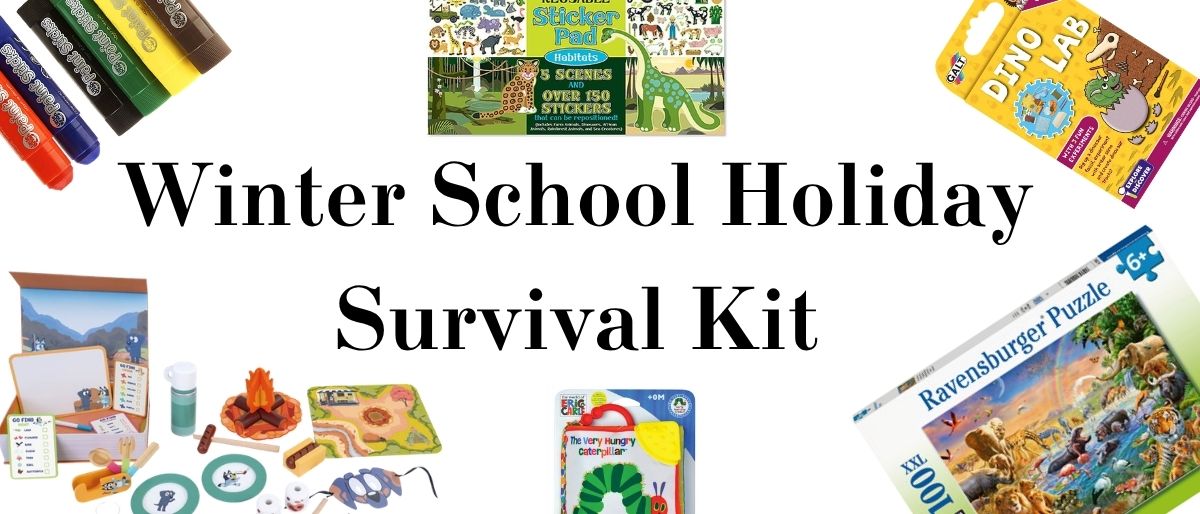
At Peekaboo Baby, we've put together a Winter School Holiday Survival Kit - a practical collection of indoor activities that are low-mess, genuinely engaging, and perfectly suited to the season. Cosy vibes included. No outdoor gear required.
Why Winter School Holidays Need Their Own Approach
In Victoria, the 2026 winter school holidays run from Monday 29 June to Friday 10 July, with Term 3 starting Monday 13 July. (Dates confirmed via vic.gov.au/school-term-dates-and-holidays-victoria - and if you're in another state, check your state education department's website, because dates vary across NSW, QLD, WA, SA, and the rest.)
That's roughly two weeks of:
-
Cold, wet, grey days that rule out most outdoor plans without a serious commitment to waterproofs
-
Shorter days and earlier darkness, which makes afternoon energy harder to manage
-
Kids who are genuinely tired from a long term two - but too wired to just rest
-
A very real risk of the TV becoming the default answer for eight hours a day
The challenge with winter holidays isn't finding activities in theory - it's finding activities that actually work inside, don't require significant adult effort to set up, hold a child's attention for more than fifteen minutes, and don't result in paint on the carpet or glitter in the couch cushions.
That's exactly what this kit is built around.
What Makes a Good Winter School Holiday Activity?
Before we get into specific recommendations, it's worth being clear about what we're optimising for. The best indoor activities for a winter school holiday break tick these boxes:
-
Low mess. Cold weather and cleaning up a craft explosion is a miserable combination. Activities that pack away in two minutes are worth their weight in gold.
-
Easy for kids to initiate themselves. The holy grail of school holiday activity is one your child can get out, do, and put away without you managing the whole process. That's how you get twenty minutes of actual quiet.
-
Long engagement time. Something that lasts ten minutes isn't a solution - it's a delay. Look for open-ended activities that can stretch across a full morning or be picked up and returned to over multiple days.
-
Screen-free or a natural complement to screen time. Not anti-screen - just something that offers a clear and appealing alternative when screens have already been on long enough.
-
Cosy enough for the season. There's genuinely something to be said for activities that feel suited to being curled up on a floor rug or the lounge room couch, rather than activities that feel like they belong on a sunny Tuesday at the park.
Here's what we recommend building into your 2026 winter school holiday rotation.
⭐ Puzzles
The Reliable Rainy-Day Activity That Never Gets Old
There is a reason puzzles have been a school holiday staple for generations. They are quiet, absorbing, genuinely satisfying when you get them right - and they work beautifully on a cold, grey July morning when you need something that just runs itself.
For the 0-6 age range, puzzles come in a genuinely wide spectrum. Chunky, large-piece first puzzles for toddlers learning to match shapes. Floor puzzles with vivid illustrations that hold a 3-year-old's attention for a full morning. More complex 24- to 48-piece puzzles for 5- and 6-year-olds who want a real challenge.
What makes puzzles particularly well-suited to winter school holidays:
-
Zero mess. Pieces go in, pieces come out, nothing ends up in the carpet fibres. A flat puzzle board means cleanup is one move.
-
Works across a wide age range. Siblings can do side-by-side puzzles without conflict, which is genuinely useful when you have a 2-year-old and a 5-year-old both needing activity at the same time.
-
Builds real skills quietly. Spatial reasoning, problem-solving, fine motor coordination, persistence - puzzles develop all of these without it feeling like "educational activity."
-
The multi-day project option. A more complex puzzle left out on a dining table becomes a running project across the whole holiday week. Kids return to it independently, parents add a piece when passing. It creates a satisfying shared achievement.
Practical tip: stash a couple of age-appropriate puzzles away before the holidays start and bring them out as fresh options. A familiar toy that has been out of sight for a month feels brand new again.
Browse puzzles for kids at Peekaboo Baby
⭐ Arts and Crafts
Creative Indoor Play That Doesn't End in a Clean-Up Operation
Craft is a school holiday essential - but in winter, the stakes feel higher. Cold days, indoor carpet, and a full tube of poster paint is a combination that tests even the most patient parent.
The key is choosing the right kind of craft for the season: activities that offer genuine creative expression and a real sense of making something, without requiring protective clothing, newspaper across the entire kitchen floor, and forty-five minutes of cleanup afterwards.
Our arts and crafts range includes several options that are specifically well-suited to low-mess indoor use:
-
Paint sticks - solid, twist-up colour that applies like a marker and doesn't require water, brushes, or a designated craft area. Little Brian paint sticks are a particular parent favourite for this age group - kids get the full experience of "doing painting" without any of the chaos that usually comes with it. The Day Glow range is especially popular for rainy days when you want the colours to feel cheerful.
-
Scratch art sets - you scratch a wooden tool across a specially coated surface to reveal rainbow colours underneath. No glue, no paint, no liquid of any kind. Just a stylus and a piece of paper. The focus required to scratch carefully is surprisingly absorbing for 3- to 6-year-olds, and the reveal element makes each piece feel magical.
-
Sticker activity pads - reusable, portable, and genuinely independent. Kids this age are deeply satisfied by placing stickers with precision. Good sticker activity books include scenes that invite storytelling and imaginative arrangement, making them more than just peel-and-stick.
-
Activity and colouring books - classics for good reason. The right colouring book for a 4-year-old can hold their attention for an entire morning, especially paired with a set of quality pencils or the paint sticks mentioned above. There is something particularly lovely about colouring in on a cold morning with a warm drink nearby.
Each of these activities works on a kitchen table, a bedroom floor, or the lounge room rug - and packs away cleanly in under two minutes. That's the goal.
⭐ Building and Construction Toys
Open-Ended Play That Lasts All Holidays (And Then Some)
If there is one category of toy that genuinely earns its keep during a school holiday break, it is building and construction sets.
The best ones don't have a single right answer. Children build something, knock it down, try again with a different idea, invent new structures, create a story around what they've made, and come back to the same set every day across the full two weeks. For a parent trying to get through the school holidays without losing their mind, that kind of open-ended engagement is invaluable.
Our building and construction range covers the full 0-6 age spectrum:
-
For babies and young toddlers (under 2 years): large, easy-grip stacking toys and soft block sets that develop object permanence, hand-eye coordination, and the deeply satisfying ritual of building a tower and knocking it over. These work well on a rug with a baby who's pulling to stand or an early walker building confidence.
-
For toddlers and preschoolers (2-4 years): chunky wooden blocks, magnetic building tiles, and simple interlocking sets where kids can follow a loose idea or freestyle. This age group benefits enormously from building because it builds spatial reasoning and early engineering thinking in a completely child-directed way.
-
For preschoolers and school-age kids (4-6+ years): more complex building kits, track layouts, and sets that can evolve into multi-day projects. A train set that gets expanded every morning, a block city that grows across the week - these are activities that give holidays a satisfying narrative arc rather than just a series of disconnected days.
Building toys are also among the best for sibling pairs. Two children at different ages can work on separate creations side by side without direct competition, which keeps the peace during a long holiday week in a way that shared-resource activities often don't.
Explore building and construction toys
⭐ Pretend Play and Role Play
Let Imagination Do the Heavy Lifting
One of the most underrated tools in the winter school holiday survival kit is simply giving kids the right props and getting out of the way.
Pretend play - role play sets, character play, imaginative scenes and dress-up scenarios - is particularly well-suited to being stuck indoors. It doesn't require much space, it doesn't generate mess in the traditional sense, it doesn't require adult direction once it gets started, and it can genuinely absorb a child for an entire morning. If you have siblings, even better - they become each other's entertainment in a way that is nothing short of miraculous.
What works especially well for this age group during the winter break:
-
Role play sets - doctor, vet, kitchen, tools, emergency services. Children aged 2-5 are deeply engaged by mimicking adult worlds. A good role play set gives them a framework for stories they'll run themselves for hours.
-
Character figurines and playsets - animals, community figures, miniature scenes. Children build stories around these in ways that often surprise parents with their depth and creativity. A small farm set or a tub of animals can fuel an entire winter holiday morning.
-
Plush and soft toy companions - for children under 3 especially, imaginative play with a soft toy friend is both comforting and completely self-directed. Plush toys become characters in elaborate scenarios that little ones narrate to themselves quietly. This is some of the most genuinely restful play for a parent to be in the room for.
The winter-specific bonus of pretend play: it is cosy by nature. Give a 3-year-old a blanket, a soft animal companion, and a couple of role play props, and you have created a warm little play world that they will return to all morning without needing you to maintain it.
Browse pretend play and role play toys
⭐ Books and Activity Books
Quiet Time That Actually Feels Like Time Well Spent
Winter school holidays are one of the best times of year to lean fully into books - and not just as a screen-time alternative, but as a genuinely lovely part of the daily rhythm that you might choose even if screens weren't on the table.
There is something very specific and very good about cold July mornings with warm blankets and a pile of books. It's one of those childhood experiences that sticks - the kind of memory that makes adults say "I used to love school holidays." You can create that deliberately for your kids this year.
Our books and activity books range includes options across the full 0-6 age range:
-
Soft books for babies and very young toddlers. Tactile, safe, and designed for little hands still learning the mechanics of turning pages. Soft fabric books are also excellent for tummy time during an indoor morning and hold up well to enthusiastic handling.
-
Board books and picture books for 1- to 3-year-olds. This is peak lap-reading age - the stage where reading together is an event, not just a bedtime routine. A new board book on a cold July morning is simple, inexpensive, and genuinely special.
-
Activity and sticker books for 3- to 6-year-olds. Children this age want to engage actively with a book, not just look at it. Activity books that include colouring pages, sticker scenes, maze activities and simple puzzles offer the sustained quiet engagement of books with the hands-on element that keeps this age group focused.
A practical approach that works well: put a basket of five or six books on the coffee table at the start of the holiday week. Include a mix of familiar favourites and one or two new additions (the library is perfect for this). Children return to it independently throughout the day, often without prompting. It costs almost nothing to set up and can fill significant time with calm, quiet activity.
A Note on Winter Sleep (Because Holidays Are Also for Rest)
Winter school holidays are not just about keeping kids entertained. They are also a natural opportunity to let the routine breathe - later mornings, slower afternoons, and the kind of genuine rest that two weeks off can provide when you don't try to schedule every hour.
If your baby or toddler's sleep has become unsettled as the temperature has dropped, it is worth checking whether their sleep environment is set up properly for winter. Getting the TOG rating right on a sleeping bag makes more difference to overnight comfort than most parents realise - and an uncomfortable baby is a wakeful baby, regardless of how good the daytime activities were.
We covered this in depth in our recent guide: What TOG Does My Baby Need? The Australian Winter Sleep Guide. If you're noticing more unsettled nights as July approaches, it's a practical read.
For TOG-rated sleeping bags for the Australian winter, browse our full baby sleeping bag range here.
Building Your Actual Winter Survival Kit
The goal here isn't to buy a new activity for every day of the holidays. It's to have a small, reliable rotation of options that you can pull out across the fortnight - something for quiet mornings, something for higher-energy periods, and something your children can access independently without asking you to set it up.
A practical starting kit might look like:
-
One puzzle at the right challenge level - challenging enough that it doesn't get finished in ten minutes, accessible enough that it doesn't become frustrating
-
One craft option - paint sticks or a sticker activity pad work well. Low setup, low cleanup, high engagement
-
One building or construction set - ideally something they haven't had access to for a while
-
A basket of books - mix of library borrows and home favourites. Rotate the selection mid-week to keep it fresh
-
One pretend play element - a role play set, a tub of figurines, or a plush companion to introduce mid-week when novelty on other activities starts to fade
The "stash and reveal" approach is consistently underestimated. A toy that has been out of circulation for six to eight weeks feels genuinely new again. Putting two or three things away in the weeks before the holidays starts, then bringing them out on Day 4 when everyone needs something fresh, is one of the most effective zero-cost strategies a parent has.
Why These Winter Activities Actually Work
Every activity in this Winter School Holiday Survival Kit was chosen because it meets the conditions that actually matter during a cold, inside-heavy school holiday break:
✔ Works entirely indoors - no outdoor space, good weather or protective gear required
✔ Low mess - cold days and significant clean-up obligations are a bad combination
✔ High engagement time - holds attention long enough to genuinely give you breathing room
✔ Encourages independent play - so you can be in the room without running the activity
✔ Develops real skills - creativity, focus, fine motor coordination, spatial reasoning, language
✔ Cosy by nature - these activities suit rugs and blankets and warm drinks beside them
They are practical. They are warm. And they make the winter school holidays feel a lot less like something to get through, and much more like a slow, genuinely enjoyable season to share with the little people in your life.
A Calmer Winter Break Starts Here
You don't need to plan every day. You don't need to be the activities coordinator for a fortnight.
You need a handful of reliable indoor tools - puzzles, craft, building sets, books and a bit of imaginative play - and the knowledge that you can rotate them across two weeks without running dry. That's a manageable winter school holiday.
Less scrambling. Less screen guilt. More of those slow, connected, cosy moments that winter school breaks are genuinely meant to be about.
Browse Peekaboo Baby's full range of indoor toys and activity ideas for kids, or explore individual categories:
And if getting the sleep environment right before the break is on your list, don't miss our Australian Winter Sleep Guide. ?
---
Frequently Asked Questions About Winter School Holiday Activities
When are the 2026 winter school holidays in Australia?
School holiday dates vary by state. In Victoria, the 2026 winter school holidays run from Monday 29 June to Friday 10 July, with Term 3 starting Monday 13 July. For the full 2026 term dates see vic.gov.au/school-term-dates-and-holidays-victoria. If you're in NSW, QLD, WA, SA, Tasmania, the ACT, or the NT, check your state or territory education department directly, as winter holiday dates differ across the country.
What are the best indoor activities for kids during the winter school holidays?
The best indoor winter school holiday activities for children aged 0-6 are low-mess, easy to set up independently, and engaging enough to hold attention for extended periods. Puzzles, arts and crafts (paint sticks, scratch art, sticker pads), building and construction toys, pretend play sets, and books all tick these boxes. A small rotating selection across the fortnight works better than having everything available at once.
How do I keep toddlers and young children entertained inside during cold weather?
A practical approach is to prepare a small "winter activity kit" before the holidays start - three to five reliable options you can rotate across the fortnight. Include one quiet activity (a puzzle or books), one creative option (a craft kit or sticker activity book), one open-ended play set (building blocks or a figurine set), and one imaginative prop (a role play kit or soft toy). Bring options out one at a time rather than all at once - novelty management is one of the most underused tools parents have.
Are paint sticks a good option for indoor winter craft with young children?
Yes - paint sticks are one of the most practical choices for indoor craft during cold months precisely because they are mess-free by design. There is no water, no brushes, no mixing, and no spills. Children apply them like a chunky marker, making them accessible even for 2-year-olds. They deliver the full experience of painting - colour mixing, large paper artworks, real creative satisfaction - without the cleanup obligation that traditional paints bring to an indoor setting.
What activities are best for babies during winter school holidays?
For babies (under 12 months), the winter school holidays are actually a lovely opportunity for more intentional floor time. Soft books for tactile exploration, activity gyms for visual and motor development, and simple stacking toys that can be knocked over again and again are all well-suited to indoor winter days. If you have older siblings at home during the break, babies often engage happily watching sibling play, which benefits development in its own right.
How can I make winter school holidays less screen-heavy?
The most effective approach is providing clear, appealing alternatives rather than just limiting screen time. When there's a puzzle out on the table, a sticker book on the couch, and a building set on the floor rug, screens become one option among several rather than the default. The activities in this guide were specifically chosen because they compete well with screens - they're tactile, they have a satisfying outcome, and they allow children to feel capable and creative, which passive screen time often doesn't provide.
What is the right TOG rating for a baby's sleeping bag in winter?
The right TOG depends on your home temperature, whether you use active heating overnight, and your baby's age and build. As a general guide, homes at 16-20 degrees typically suit a 2.5 TOG sleeping bag, while warmer rooms (20-24 degrees) may only need 1.0 TOG. For a comprehensive guide tailored to Australian winters and home conditions, see our Australian Winter Sleep Guide, or browse our baby sleeping bag range by TOG rating.